

280E and Cannabis Tax built on defensible COGS.
280E tax help for cannabis operators who want cost of goods sold calculated correctly, medical and adult-use activity documented, and returns they can stand behind.
Section 280E turns an ordinary tax return into a cost accounting exercise. Because it denies deductions and credits to businesses trafficking in Schedule I or II substances, your federal outcome depends heavily on cost of goods sold, and on an inventory method that follows the §471 rules courts have applied narrowly to cannabis. Partial rescheduling adds a new layer: medical and adult-use activity may now be treated differently, and records need to show which is which. TreeStar's 280E tax work brings inventory costing, allocation, and federal and California returns together, documented for the questions an examiner will ask.
Where it gets complicated
- 01 COGS carries the return
Under §280E, cost of goods sold still reduces gross receipts even though most other deductions do not. That makes your inventory method, your records, and your Form 1125-A the core of the return.
- 02 Narrow inventory rules
Which costs belong in inventory follows the §471 rules, and courts have rejected using the §263A capitalization rules to bring in costs §280E would otherwise deny. Resellers and producers also face different limits.
- 03 Medical and adult-use split
A federal order moved state-licensed medical cannabis to Schedule III, while adult-use cannabis remains Schedule I and subject to §280E. Treasury has not issued detailed rules for operators doing both, so how you allocate costs, and how you document it, matters.
- 04 Small business methods
Businesses that meet the gross receipts test may have simplified inventory options under §471(c). How those methods interact with §280E is contested, so any method change needs careful support.
- 05 California's separate math
California does not apply §280E to licensed cannabis businesses, so the state return allows deductions the federal return denies. Keeping both computations in step avoids mismatches that invite questions.
How TreeStar helps
We review past returns and the inventory records behind them to see whether COGS was computed consistently and supportably, before anyone discusses amending.
→ cleanup_catch_up Rebuild inventory supportWhere records are thin, we reconstruct inventory and cost support for open years from purchase, production, and track-and-trace data.
→ entity_tax_strategy Structure activities with careWe analyze how your entities, licenses, and medical and adult-use activities are organized for tax, and coordinate any change with your attorney.
→ tax_controversy Respond to IRS scrutinyWhen an exam or notice arrives, our Enrolled Agents can represent you and present the inventory and allocation support we built with you.
→What you can expect
A documented, consistent inventory method
Allocations you can explain to an examiner
Federal and California returns that tie together
Common questions
Does medical cannabis still fall under 280E?
§280E applies to Schedule I and II substances, and state-licensed medical cannabis now sits in Schedule III, so medical activity may fall outside it. Adult-use activity remains subject to §280E, and without detailed Treasury rules for mixed operators, we review your facts and documentation before relying on any change.
Should we amend prior returns?
It depends on your facts. If prior COGS was computed inconsistently or left out costs the inventory rules allow, an amended return may be worth considering, while positions based on where the law might be heading carry real risk. We review the records and the open years with you, and with your attorney where needed, before recommending anything.
Do separate entities change how 280E applies?
Sometimes, but generally only when the activities are genuinely separate businesses with their own substance, records, and pricing. Courts have looked past arrangements that existed mainly on paper, so we analyze the facts with your attorney before any restructuring.
Need a referral?
We work alongside the attorneys, consultants, and other specialists your industry relies on. Tell us what you need and we will make an introduction.
Licensing, entity structure, contracts, and regulatory questions.
→ request_referral Metrc and track-and-trace specialistSetup, cleanup, and training so the system matches the shelf.
→ request_referral Compliance consultantStandard operating procedures, inspections, and state and local readiness.
→ request_referral Insurance brokerCoverage for product, property, crops, and liability in regulated markets.
→ request_referral Banking and payment solutionsInstitutions and processors that serve licensed operators.
→Highly Regulated Industries insights
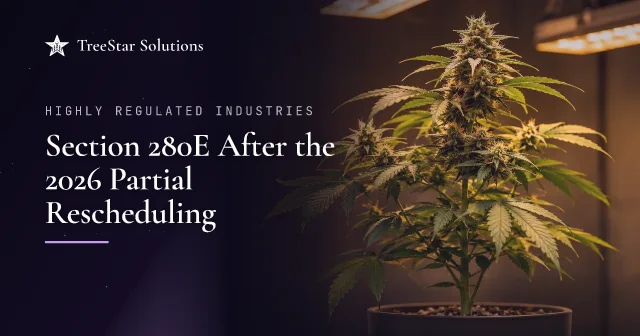
Medical cannabis moved to Schedule III in 2026. Adult-use did not. What that means for §280E, cost of goods sold, and your California return.
→
Six what-if scenarios for regulated businesses, from a banned product to a lost processor: what breaks first, the warning signs, and the first moves.
→
Regulation is a variable, not a constant. How to model ranges, scenarios, triggers, and reserves for rules that keep moving.
→